Know your rights as an air traveler
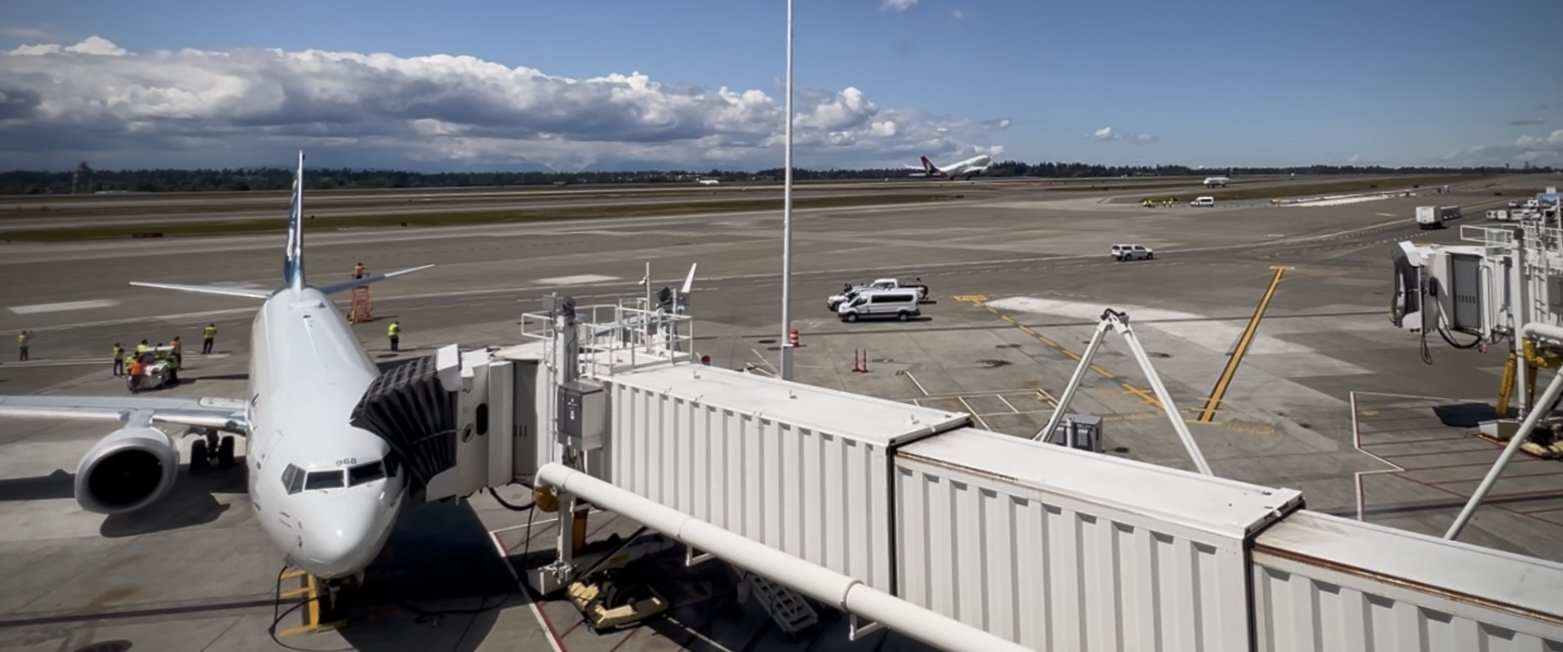
A plane sits alongside a jet bridge as a flight takes off and another lands at SeaTac. Adventuresome Co. photo.
It happens every year: something causes widespread airport chaos. Whether the issues started with bad weather, mechanical problems, technology outages, a government shutdown, or something else, it is imperative that air travelers know their rights. That’s where the U.S. Department of Transportation’s Fly Rights – which were established as an aid to the protection of consumers – come in.
Contracts of carriage, between passengers and airlines, are agreed to at the time of ticket purchase and often favor the businesses involved in the transactions. Knowing your rights can help protect you, and even assist in remedying issues that might arise during your travels. Keep in mind that airlines differ from one another not only in service quality and mileage program structures, but also in what they will or will not provide in the event of delays, cancellations and more.
Delays and cancellations
With millions of flights taking off each year, some level of delays and cancellations is inevitable. In 2024, reporting airlines posted an on-time arrival rate of 78.10%, according to a March 2025 report from the DOT; that’s a slight drop from 2023, while the cancellation rate was slightly up. What an airline might do for you in the event of such inconveniences will vary from company to company.
First and foremost, always check your flight status before leaving for the airport. Check your individual flight first. You can also access the Federal Aviation Administration website to see if there are widespread delays at your departure or destination airports.
Whether it’s a delay or a cancellation that you’re dealing with, if you are already at the airport and the wait until your newly-scheduled flight is significant, request what you can, such as accommodations coverage or meal vouchers. For cancelled flights specifically, if you no longer wish to take the trip, you should request a refund from the airline, which is required to refund your money in such cases. Alternatively, if you still want to fly, most airlines will rebook you on their first flight available at no additional cost. During high traffic or major delay windows, however, those rebookings can come days after your original itinerary! In that case, consider asking if the airline can put you on a flight with another carrier.
Again, many of the policies vary from airline to airline, and some budget airlines will not provide any amenities, so consider that when booking and check with your carrier to see what could be available to you.
Overbooking
Also known as “bumping,” it is possible for paid passengers to be moved from a flight due to overbooking, which can lead to a ticketed passenger being involuntarily bumped from a flight. In such cases, airlines are to provide you with information about your rights, and they may owe you compensation (in the form of a check or cash) on top of your original ticket, unless they are able to get you to your destination within one hour of your already-scheduled arrival time. According to the DOT, overbooking is “not illegal,” and airlines will overbook to a certain extent to make up for no-shows or passengers who change flights at the last minute.
As usual, there are exceptions, and airlines will typically try to get volunteers to take different flights for credit instead of having to pony up for an involuntary bump. However, if you are involuntarily bumped off your flight, you are entitled to compensation. Minimum payment amounts depend on the price of the original ticket and the length of the delay, and the airline can choose to only meet the DOT’s requirements or may opt to exceed them.
Luggage
No shade to the thousands of luggage handlers who do the hard work of moving bags from place to place, but when you check a bag, you might as well expect that it will be tossed around, moving along several conveyor belts, passing through multiple hands and maybe even getting dropped down chutes on its way from your departure city to (hopefully) your destination!
So what can you do to make things easier on both the behind-the-scenes crew and yourself? To start, pack in an organized manner, be sure to secure any liquids and other fragile items in proper packaging, and don’t overfill your bag, which can strain zippers and clasps and lead to you receiving your items in broken piece of luggage held together by a plastic bag.
There is a lot that you can control, but only before you check your bag in, and though airlines and the DOT maintain that the vast majority of checked baggage makes it safely to their destinations, bags do get damaged, delayed and lost.
Damages: Airlines will usually pay for repairs of damaged bags; if a piece of luggage cannot be repaired, the airline might offer you a settlement payment or a trade-in for a new bag. You should immediately go to your airline’s baggage office if you notice damage to your luggage. Take photos right away, and be prepared to wait for an agent in order to start the claims process, if one is available.
Delays: Depending on the size of the aircraft, your flight could have thousands of bags on board! Don’t panic if your checked luggage doesn’t come out right away; certain large and oddly-shaped checked baggage will also not be on a standard luggage belt, but instead be in an oversized section. Now, if you do not receive your baggage, report it to your airline’s baggage office right away, and see if they have any information they can give you. If you cannot track down your bag, make sure that a report is created and that you keep a record of that report; ask what the airline can provide, monetarily or otherwise, and check on what they will cover; and, as usual, keep any documents and receipts related to necessities you had to replace while you were waiting to receive your bag. Also note that airlines won’t always deliver your bag to your location, such as a hotel or hostel, without charge, so be sure to ask about that before leaving the airport as well.
Losses: If your luggage has been declared permanently lost, you’ll have to submit another form as part of your claim. If you don’t do this, or don’t do it by the deadline, you may lose your chance to claim anything at all. Airlines also have liability limits, and if the value of your baggage exceeds the limit, you may want to purchase “excess valuation” coverage from your airline, if available.
Don’t forget to keep valuables with you at all times! That means in your carry-on bag, and not in checked luggage that could arrive late or be lost. Consider keeping items of importance – including but not limited to cash, credit cards, identification cards, jewelry, business papers, tour vouchers, prescriptions, fragile items, medical devices and key baby items – on your person and not in baggage from which you are separated. Perishables should not be left in checked bags, if possible, since a delay of your baggage could mean nasty spoilage.
Also remember that airlines sometimes have later-boarding passengers gate check luggage once overhead bin space is filled, so you may want to opt for a bag small enough to place under the seat in front of you to ensure there will be space to take it on board.
Travel insurance
Added insurance can serve as another layer of protection on your travels… but beware the classic travel insurance scheme!
Did you know that many credit cards offer travel insurance as part of consumers’ agreements with them? In addition, airline rewards programs’ higher tiers will often include options to refund tickets as a credit for a future flight or similar. However, you should never assume that you’re covered, always take the time to see what benefits you might already have under any credit cards or loyalty programs, and make sure you’re reading the fine print anytime you are purchasing tickets.
Now, let’s talk about what to do when those airlines offer you travel insurance. Is it worth it? The answer will vary, depending on your situation. Extra insurance can no doubt be invaluable, especially if you’re traveling abroad! Perhaps you need a solid option to cancel your trip, rather than purchasing a fully-refundable fare. Or maybe you’re anticipating disruptions that could lead to delays, cancellations or issues with baggage. In some cases, travel insurance can actually cover more than the cost of your trip. Again, read the fine print, and all of the fine print! And keep in mind that travel insurance doesn’t cover everything – for example, pandemics, travel to red-alert countries, extreme sports, and civil unrest are generally not included, but the terms vary by company and coverage level.
Group travel
Teams, tour groups, school trips and more mean lots of logistics involved in planning, and it can feel overwhelming when something goes sideways with multiple people on an itinerary. If you run into an issue while traveling in a group, consider having the traveler with the highest travel status be the one to contact an airline agent, and use their frequent flyer number to do so. This could put you in a higher position based on the airline’s loyalty program tier and shorten your wait time significantly. Additionally, contacting the international phone line can be useful, though there may be language barrier issues.
Final note
You have the option to file direct complaints with airlines, and – as a passenger of an airline who is traveling within the United States or as a passenger of a U.S.-based airline – to file formal complaints with the DOT, which you can do on its website. Any time you are signing up for air travel, be prepared for things to go a bit awry. Be kind. Know that agents are almost always trying to help you as quickly as they can, and that you’re not the only one looking for assistance. And, as always, pack your patience!
Please note that the above information isn’t legal guidance and is only meant to inform you of what options you might have in the event of a disruption. Per the DOT, you can file consumer or civil rights complaints online by clicking here. Alternatively, you can mail complaints to the following address: Office of Aviation Consumer Protection, U.S. Department of Transportation, C-70, W96-432, 1200 New Jersey Avenue, SE, Washington, DC, 20590.